Recombinant Mouse Pituitary homeobox 1 (Pitx1)
-
中文名稱:小鼠Pitx1重組蛋白
-
貨號(hào):CSB-YP018042MO
-
規(guī)格:
-
來源:Yeast
-
其他:
-
中文名稱:小鼠Pitx1重組蛋白
-
貨號(hào):CSB-EP018042MO-B
-
規(guī)格:
-
來源:E.coli
-
共軛:Avi-tag Biotinylated
E. coli biotin ligase (BirA) is highly specific in covalently attaching biotin to the 15 amino acid AviTag peptide. This recombinant protein was biotinylated in vivo by AviTag-BirA technology, which method is BriA catalyzes amide linkage between the biotin and the specific lysine of the AviTag.
-
其他:
-
中文名稱:小鼠Pitx1重組蛋白
-
貨號(hào):CSB-BP018042MO
-
規(guī)格:
-
來源:Baculovirus
-
其他:
-
中文名稱:小鼠Pitx1重組蛋白
-
貨號(hào):CSB-MP018042MO
-
規(guī)格:
-
來源:Mammalian cell
-
其他:
產(chǎn)品詳情
-
純度:>85% (SDS-PAGE)
-
基因名:Pitx1
-
Uniprot No.:
-
別名:Pitx1; Bft; Potx; Ptx1; Pituitary homeobox 1; Hindlimb-expressed homeobox protein backfoot; Homeobox protein P-OTX; Homeobox protein PITX1; Paired-like homeodomain transcription factor 1; Pituitary OTX-related factor
-
種屬:Mus musculus (Mouse)
-
蛋白長(zhǎng)度:Full length protein
-
表達(dá)區(qū)域:1-315
-
氨基酸序列MDAFKGGMSL ERLPEGLRPP PPPPHDMGPS FHLARAADPR EPLENSASES SDADLPDKER GGEAKGPEDG GAGSAGCGGG AEDPAKKKKQ RRQRTHFTSQ QLQELEATFQ RNRYPDMSMR EEIAVWTNLT EPRVRVWFKN RRAKWRKRER NQQLDLCKGG YVPQFSGLVQ PYEDVYAAGY SYNNWAAKSL APAPLSTKSF TFFNSMSPLS SQSMFSAPSS ISSMTMPSSM GPGAVPGMPN SGLNNINNLT GSSLNSAMSP GACPYGTPAS PYSVYRDTCN SSLASLRLKS KQHSSFGYGG LQGPASGLNA CQYNS
-
蛋白標(biāo)簽:Tag?type?will?be?determined?during?the?manufacturing?process.
The tag type will be determined during production process. If you have specified tag type, please tell us and we will develop the specified tag preferentially. -
產(chǎn)品提供形式:Lyophilized powder
Note: We will preferentially ship the format that we have in stock, however, if you have any special requirement for the format, please remark your requirement when placing the order, we will prepare according to your demand. -
復(fù)溶:We recommend that this vial be briefly centrifuged prior to opening to bring the contents to the bottom. Please reconstitute protein in deionized sterile water to a concentration of 0.1-1.0 mg/mL.We recommend to add 5-50% of glycerol (final concentration) and aliquot for long-term storage at -20℃/-80℃. Our default final concentration of glycerol is 50%. Customers could use it as reference.
-
儲(chǔ)存條件:Store at -20°C/-80°C upon receipt, aliquoting is necessary for mutiple use. Avoid repeated freeze-thaw cycles.
-
保質(zhì)期:The shelf life is related to many factors, storage state, buffer ingredients, storage temperature and the stability of the protein itself.
Generally, the shelf life of liquid form is 6 months at -20°C/-80°C. The shelf life of lyophilized form is 12 months at -20°C/-80°C. -
貨期:Delivery time may differ from different purchasing way or location, please kindly consult your local distributors for specific delivery time.Note: All of our proteins are default shipped with normal blue ice packs, if you request to ship with dry ice, please communicate with us in advance and extra fees will be charged.
-
注意事項(xiàng):Repeated freezing and thawing is not recommended. Store working aliquots at 4°C for up to one week.
-
Datasheet :Please contact us to get it.
產(chǎn)品評(píng)價(jià)

相關(guān)產(chǎn)品
靶點(diǎn)詳情
-
功能:Sequence-specific transcription factor that binds gene promoters and activates their transcription. May play a role in the development of anterior structures, and in particular, the brain and facies and in specifying the identity or structure of hindlimb. Can independently activate and synergize with PIT-1 on pituitary-specific target gene promoters, thus may subserve functions in generating both precursor and specific cell phenotypes in the anterior pituitary gland and in several other organs. Can activate pituitary transcription of the proopiomelanocortin gene.
-
基因功能參考文獻(xiàn):
- Pitx1 distal enhancer loss have only mild effects on Pitx1 expression in the hindlimb and no overt effects on hindlimb or mandibular morphology. PMID: 29549111
- data suggest that PITX1 promotes chondrogenesis and myogenesis in the hindlimb by direct regulation of several key members of the cartilage and muscle transcriptional networks. PMID: 29273440
- Results indicate autonomously programmed differences in forelimb and hindlimb cartilage precursors of the limb skeleton are controlled, at least in part, by Pitx1 and suggest this has an important role in generating distinct limb-type morphologies. PMID: 28746404
- Pitx1 targets sites that are in a similar chromatin state in Forelimbs (FLs) and hindlimbs and controls expression of patterning genes as well as the chondrogenic program. PMID: 28807899
- Pitx1 influences hindlimb morphology both through the activation of hindlimb-specific enhancers as well as through the hindlimb-specific modulation of enhancers that are active in both sets of limbs PMID: 23201014
- The results suggest that PITX2 and PITX1 have overlapping roles in thyrotroph function and response to hypothyroidism. PMID: 21964592
- PITX1 haploinsufficiency may cause a developmental field defect preferentially affecting the lateral lower leg. PMID: 21775501
- It was shown that, firstly, Pitx1 influences hindlimb outgrowth by regulating Tbx4 expression levels and that, subsequently,Pitx1 shapes hindlimb bone and soft tissue morphology independently of Tbx4. PMID: 22071103
- These findings provide evidence that c-Abl participates in modulating Pitx1 expression in the apoptotic response to DNA damage. PMID: 20563669
- Thus, Pitx1 and Pitx2 genes are required for sustained hindlimb bud growth and formation of hindlimbs PMID: 12441290
- expression during cardiovascular development PMID: 12858527
- PITX1 autoregulation depends on DNA-binding and trans-activation domains of Pitx1 and it may be responsible for establishment and/or maintenance of the Pitx1 expression domain. PMID: 14512705
- Results suggest that pituitary homeobox 1 (Pitx-1) can direct transactivation of the mouse gonadotropin-releasing hormone receptor gene, in part by DNA binding and in part by an action of Pitx-1 as a cofactor for AP-1 PMID: 15226417
- Although PITX1 protein is present in expression pattern similar to PITX2 throughout pituitary development, it has less prominent role than PITX2. PMID: 15761027
- These results demonstrate that Pitx1, but not Tbx4, determines the morphological identity of hindlimb tissues. PMID: 16989801
- Deletion of the Pitx1 genomic locus affects mandibular morphogenesis and expression of the Barx1 and Tbx1 genes. PMID: 18082678
顯示更多
收起更多
-
亞細(xì)胞定位:Nucleus.
-
蛋白家族:Paired homeobox family, Bicoid subfamily
-
組織特異性:Expressed in primordial Rathke pouch, oral epithelium, first branchial arch, duodenum, and hindlimb.
-
數(shù)據(jù)庫(kù)鏈接:
Most popular with customers
-
-AC1.jpg)
Recombinant Human Microtubule-associated protein tau (MAPT) (Active)
Express system: Mammalian cell
Species: Homo sapiens (Human)
-
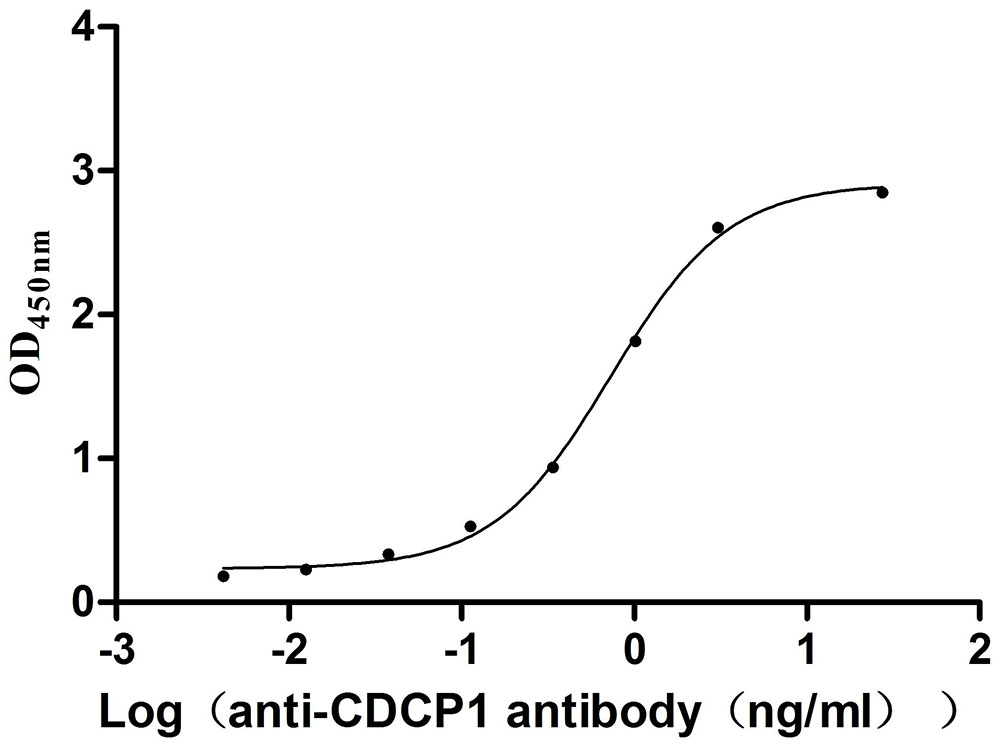
Recombinant Mouse CUB domain-containing protein 1 (Cdcp1), partial (Active)
Express system: Mammalian cell
Species: Mus musculus (Mouse)
-

Recombinant DT3C (Diphtheria toxin & spg 3C domain) for Antibody Internalization Assay (Active)
Express system: E.coli
Species: N/A