在多細(xì)胞生物體中,細(xì)胞間的連接對(duì)于維持組織結(jié)構(gòu)完整性、實(shí)現(xiàn)物質(zhì)選擇性轉(zhuǎn)運(yùn)和信號(hào)傳遞至關(guān)重要。其中,緊密連接(Tight Junctions, TJs)作為一種特化的細(xì)胞間連接復(fù)合體,構(gòu)筑了關(guān)鍵的生理屏障。而Claudin蛋白家族,正是構(gòu)成這些緊密連接的核心組分。
Claudin蛋白在皮膚、消化道、呼吸道、腎臟以及血腦屏障等多種組織中廣泛分布。它們協(xié)同作用,確保生理屏障既能有效阻隔有害物質(zhì)(如病原體、毒素)的跨細(xì)胞間隙滲透,又能精準(zhǔn)調(diào)控水、離子及小分子的選擇性通透,從而維持內(nèi)環(huán)境的穩(wěn)態(tài)。
Claudin蛋白是一類四次跨膜蛋白,其N端和C端均位于細(xì)胞質(zhì)內(nèi)。它們通過(guò)細(xì)胞外環(huán)區(qū)與相鄰細(xì)胞膜上的Claudin分子相互作用,形成線性的纖維狀結(jié)構(gòu),即“緊密連接鏈(Claudin strands)”。這些連接鏈緊密融合相鄰細(xì)胞的質(zhì)膜,有效封閉了細(xì)胞間的間隙,從而構(gòu)成了物理屏障的骨架。
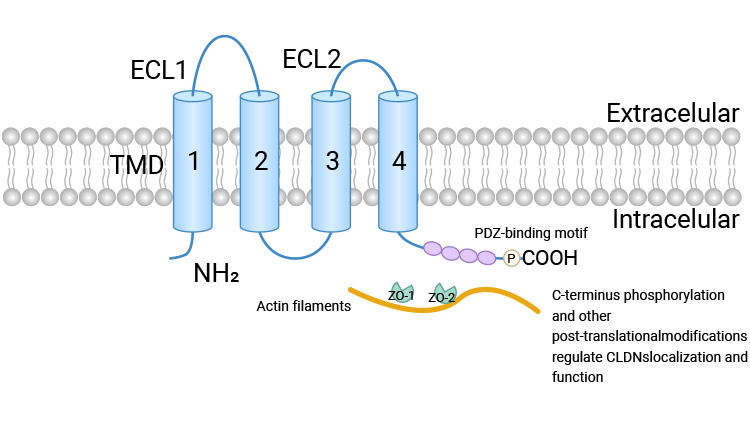
Claudin蛋白結(jié)構(gòu)示意圖 [1]
目前,人類基因組中已鑒定出至少27個(gè)Claudin家族成員(Claudin-1至Claudin-27)。盡管同屬一家族,但不同Claudin蛋白在組織分布、表達(dá)水平及其在緊密連接中的具體功能上存在顯著差異,使其能夠適應(yīng)不同組織的生理需求。
Claudin蛋白的核心功能主要體現(xiàn)在兩方面:
Claudin蛋白通過(guò)形成連續(xù)的細(xì)胞間"密封"結(jié)構(gòu),有效阻止水溶性分子、離子和微生物在細(xì)胞間隙的自由滲透。這對(duì)于維護(hù)各器官內(nèi)部環(huán)境的獨(dú)立性和穩(wěn)定性至關(guān)重要,例如腸道屏障阻止有害物質(zhì)進(jìn)入循環(huán)系統(tǒng),血腦屏障則保護(hù)中樞神經(jīng)系統(tǒng)免受血液中潛在有害物質(zhì)的侵?jǐn)_。
除了阻隔作用,特定的Claudin蛋白還能形成納米級(jí)的"旁細(xì)胞水性孔道(paracellular pores)",介導(dǎo)離子和小分子在細(xì)胞間隙的選擇性轉(zhuǎn)運(yùn)。Claudin成員的種類和組合決定了這些孔道的電荷選擇性和大小選擇性,從而實(shí)現(xiàn)對(duì)鈣、鎂、鈉、氯等離子的精確重吸收和分泌,對(duì)維持機(jī)體的水鹽平衡和物質(zhì)代謝具有關(guān)鍵作用。
正是由于Claudin蛋白在構(gòu)建和調(diào)控生理屏障中的核心作用,其功能或表達(dá)的異常與多種疾病的發(fā)生發(fā)展密切相關(guān)。因此,Claudin蛋白家族已成為生物醫(yī)學(xué)研究的重要焦點(diǎn),被廣泛關(guān)注。
研究表明,Claudin蛋白的失調(diào)與多種人類疾病(如癌癥、炎癥性疾病、代謝疾病和感染)存在關(guān)聯(lián)。鑒于其在病理生理過(guò)程中的關(guān)鍵地位,Claudin蛋白不僅為深入理解疾病機(jī)制提供了重要線索,也展現(xiàn)出作為診斷標(biāo)志物和潛在藥物靶點(diǎn)的巨大潛力。針對(duì)Claudin蛋白的功能調(diào)控有望為多種頑固性疾病的治療帶來(lái)創(chuàng)新策略。
Claudin 蛋白在不同組織和器官中的表達(dá)模式存在顯著差異。深入理解這些特異性的表達(dá)模式對(duì)于研究者選擇合適的陽(yáng)性對(duì)照、準(zhǔn)確解讀實(shí)驗(yàn)結(jié)果以及探索 Claudin 蛋白的生理功能至關(guān)重要。
表 Claudin 蛋白在主要人體組織/器官中的表達(dá)特征
| 組織 / 器官 | 主要表達(dá)的 Claudin 成員 | 功能特點(diǎn) |
|---|---|---|
| 皮膚 | CLDN1, CLDN4, CLDN7, CLDN11 | 構(gòu)建表皮屏障,防止水分流失和病原入侵 |
| 肝臟 | CLDN1, CLDN2, CLDN3, CLDN5 | 維持肝細(xì)胞極性,參與膽汁分泌屏障 |
| 腎臟 | CLDN2, CLDN4, CLDN7, CLDN8, CLDN10, CLDN16, CLDN19 | 調(diào)控離子選擇性重吸收與屏障功能 |
| 腸道 | CLDN1, CLDN2, CLDN3, CLDN4, CLDN7, CLDN15 | 平衡屏障完整性與營(yíng)養(yǎng)/離子旁細(xì)胞通透 |
| 肺 | CLDN1, CLDN3, CLDN4, CLDN5, CLDN18.1 | 維持氣道及肺泡上皮屏障 |
| 胃 | CLDN18.2, CLDN18.1 | 胃黏膜上皮特異性表達(dá) |
| 腦(血腦屏障) | CLDN5, CLDN3 | 構(gòu)建高電阻內(nèi)皮屏障,限制物質(zhì)入腦 |
| 睪丸 | CLDN3, CLDN5, CLDN11 | 形成血-睪屏障 |
| 乳腺 | CLDN1, CLDN3, CLDN4, CLDN7 | 維持導(dǎo)管上皮極性與分泌功能 |
| 胎盤 | CLDN1, CLDN4, CLDN5 | 調(diào)控母胎界面物質(zhì)交換屏障 |
Claudin 家族的不同成員被證實(shí)與多種疾病的發(fā)生發(fā)展密切相關(guān),這使得它們成為極具價(jià)值的生物標(biāo)志物和潛在的治療靶點(diǎn)。下表總結(jié)了 Claudin 成員與主要疾病的關(guān)聯(lián),旨在幫助您快速識(shí)別與您研究方向相關(guān)的靶點(diǎn)。
表 Claudin 家族在不同疾病中的表達(dá)
| 疾病類型 | Claudin成員 | 表達(dá) | 參考文獻(xiàn) |
|---|---|---|---|
|
乳腺癌
|
CLDN1 | ↓(降低) | [2] |
| CLDN2 | ↑(升高) | [3] | |
| CLDN4 | ↑ | [4] | |
| CLDN7 | ↓ | [5] | |
| CLDN8 | ↑↓(表達(dá)變化不一致) | [6][7] | |
|
結(jié)直腸癌
|
CLDN1 | ↑ | [8] |
| CLDN2 | ↑ | [9] | |
| CLDN3 | ↑ | [10] | |
| CLDN4 | ↑ | [9] | |
| CLDN6 | ↓ | [9] | |
| CLDN18 | ↑ | [9] | |
|
胃癌
|
CLDN1 | ↑ | [11] |
| CLDN3 | ↑ | [12] | |
| CLDN4 | ↑ | [13] | |
| CLDN5 | ↑ | [17] | |
| CLDN6 | ↑ | [14] | |
| CLDN7 | ↑ | [15] | |
| CLDN9 | ↑ | [52] | |
| CLDN18.2 | ↑ | [16] | |
|
肺癌(包括非小細(xì)胞肺癌)
|
CLDN1 | ↓ | [18] |
| CLDN2 | ↑ | [19] | |
| CLDN3 | ↓ | [20] | |
| CLDN5 | ↓ | [21] | |
| CLDN6 | ↓ | [22] | |
| CLDN7 | ↓ | [23] | |
|
肝細(xì)胞癌
|
CLDN1 | ↑ | [24] |
| CLDN3 | ↓ | [25] | |
| CLDN5 | ↓ | [26] | |
| CLDN9 | ↑ | [27] | |
| CLDN11 | ↓ | [28] | |
| CLDN14 | ↓ | [29] | |
| CLDN17 | ↑ | [30] | |
|
宮頸癌
|
CLDN1 | ↑ | [31] |
| CLDN12 | ↓ | [32] | |
| CLDN18 | ↑ | [33] | |
|
肝纖維化
|
CLDN1 | ↑ | [34] |
|
腎癌
|
CLDN3 | ↓ | [35] |
| CLDN4 | ↓ | [36] | |
| CLDN7 | ↓ | [37] | |
| CLDN8 | ↓ | [38] | |
| CLDN10 | ↑ | [39] | |
|
卵巢癌
|
CLDN1 | ↓ | [40] |
| CLDN3 | ↑ | [41] | |
| CLDN4 | ↑ | [42] | |
| CLDN5 | ↓ | [43] | |
| CLDN7 | ↑ | [44] | |
|
甲狀腺癌
|
CLDN1 | ↑ | [45] |
|
胰腺癌
|
CLDN1 | ↓ | [46] |
| CLDN4 | ↑ | [47] | |
| CLDN18.2 | ↑ | [48] | |
|
前列腺癌
|
CLDN1 | ↑ | [49] |
| CLDN3 | ↑ | [50] | |
| CLDN4 | ↑ | [50] | |
| CLDN5 | ↑ | [51] |
Claudin 領(lǐng)域正處于快速發(fā)展階段,多個(gè)家族成員作為極具前景的治療靶點(diǎn)和診斷標(biāo)志物而備受關(guān)注。以下是目前活躍研究中的幾個(gè)關(guān)鍵靶點(diǎn)和領(lǐng)域:
CLDN18.2 是一種在正常胃粘膜上皮細(xì)胞中高度特異性表達(dá)的 Claudin 蛋白,而在正常組織中表達(dá)極低。然而,它卻在胃癌和胰腺癌等多種惡性腫瘤中普遍存在高表達(dá),使其成為一個(gè)理想的腫瘤特異性靶點(diǎn)。這一獨(dú)特的表達(dá)模式賦予了 CLDN18.2 巨大的應(yīng)用潛力,尤其是在嵌合抗原受體 T 細(xì)胞(CAR-T)療法和抗體偶聯(lián)藥物(ADCs)等新型癌癥免疫治療領(lǐng)域。
查看 CLDN18.2 相關(guān)產(chǎn)品CLDN3作為緊密連接關(guān)鍵組分,不僅參與維持上皮細(xì)胞極性與屏障功能,還在調(diào)控基因轉(zhuǎn)錄、細(xì)胞增殖分化、代謝及免疫微環(huán)境等方面發(fā)揮多維作用。其在腫瘤中的作用復(fù)雜且高度依賴組織背景:在肝癌中通過(guò)抑制Wnt/β-catenin-EMT軸和調(diào)控膽汁酸代謝發(fā)揮抑癌作用;而在肺腺癌、結(jié)直腸癌及卵巢癌中則異常高表達(dá),激活PI3K-Akt、ERK或JNK/AP-1等通路促進(jìn)惡性進(jìn)展。這種"抑癌-促癌"雙重特性使其成為需精準(zhǔn)匹配適應(yīng)癥的重要靶向干預(yù)節(jié)點(diǎn)。
查看 CLDN3相關(guān)產(chǎn)品CLDN4在正常組織中表達(dá)受限,卻在胰腺癌、胃癌、卵巢癌等多種惡性腫瘤中顯著上調(diào),具有高度腫瘤選擇性。其參與調(diào)控細(xì)胞極性、信號(hào)傳導(dǎo)及耐藥機(jī)制,已成為熱門的免疫治療靶點(diǎn)。目前,靶向CLDN4的雙抗藥物ASP-1002已進(jìn)入臨床開發(fā)階段,展現(xiàn)出良好的安全性和初步療效,有望填補(bǔ)難治性實(shí)體瘤的治療空白。
查看 CLDN4相關(guān)產(chǎn)品CLDN6在成人正常組織中幾乎不表達(dá),但在多種癌癥(如睪丸癌、子宮內(nèi)膜癌、肺癌)中重新激活,具備理想腫瘤特異性抗原特征。因其在"免疫冷腫瘤"中的高表達(dá),CLDN6成為激活抗腫瘤免疫應(yīng)答的重要突破口。ADC、CAR-T細(xì)胞療法及雙特異性抗體等前沿技術(shù)正加速推進(jìn)CLDN6靶向治療,多項(xiàng)臨床管線已展現(xiàn)初步療效。
查看 CLDN6相關(guān)產(chǎn)品CLDN9是緊密連接蛋白家族中研究較少但極具潛力的成員。近期研究發(fā)現(xiàn),CLDN9在胃癌組織中呈現(xiàn)特異性高表達(dá),且與腫瘤侵襲性增強(qiáng)及不良預(yù)后顯著相關(guān)。其在正常組織中表達(dá)受限,賦予其良好的治療窗口。隨著對(duì)其在胃癌發(fā)生發(fā)展中作用機(jī)制的逐步揭示,CLDN9正成為抗體類藥物差異化布局的新方向,有望為胃癌精準(zhǔn)治療提供全新選擇。
查看 CLDN9相關(guān)產(chǎn)品華美生物提供覆蓋 27種Claudin家族成員的完整科研工具,包括高純度重組蛋白、經(jīng)多平臺(tái)驗(yàn)證的抗體以及高靈敏度ELISA試劑盒,助力從基礎(chǔ)機(jī)制到轉(zhuǎn)化應(yīng)用的全鏈條研究。無(wú)論您聚焦 CLDN18.2、CLDN6 等熱門靶點(diǎn),還是探索其他 Claudin 成員的生物學(xué)功能,我們都為您準(zhǔn)備了可靠、高效的實(shí)驗(yàn)解決方案。
| Target | Code | Product Name | Source |
|---|---|---|---|
| Cldn1 | CSB-EP005490RA1 | Recombinant Rat Claudin-1 (Cldn1), partial | E.coli |
| CLDN1 | CSB-CF005490HU | Recombinant Human Claudin-1 (CLDN1) | in vitro E.coli expression system |
| CLDN1 | CSB-MP005490HU | Recombinant Human Claudin-1 (CLDN1)-VLPs (Active) | Mammalian cell |
| CLDN1 | CSB-CF005490HUd7 | Recombinant Human Claudin-1 (CLDN1) | in vitro E.coli expression system |
| Cldn1 | CSB-CF005490RA | Recombinant Rat Claudin-1 (Cldn1) | in vitro E.coli expression system |
| CLDN3 | CSB-EP005505HU1a6 | Recombinant Human Claudin-3 (CLDN3), partial | E.coli |
| CLDN3 | CSB-CF005505HU | Recombinant Human Claudin-3 (CLDN3) | in vitro E.coli expression system |
| CLDN3 | CSB-MP005505HU | Recombinant Human Claudin-3 (CLDN3)-VLPs (Active) | Mammalian cell |
| CLDN4 | CSB-MP005506HU | Recombinant Human Claudin-4 (CLDN4)-VLPs (Active) | Mammalian cell |
| CLDN4 | CSB-CF005506HU | Recombinant Human Claudin-4 (CLDN4) | in vitro E.coli expression system |
| CLDN4 | CSB-MP005506HU-D | Recombinant Human Claudin-4 (CLDN4)-Detergent | Mammalian cell |
| Cldn5 | CSB-CF867513RA | Recombinant Rat Claudin-5 (Cldn5) | in vitro E.coli expression system |
| CLDN6 | CSB-CF005508HU | Recombinant Human Claudin-6 (CLDN6), partial | in vitro E.coli expression system |
| CLDN6 | CSB-MP005508HU(A4) | Recombinant Human Claudin-6 (CLDN6)-VLPs (Active) | Mammalian cell |
| CLDN6 | CSB-MP005508HU(A4)f4 | Recombinant Human Claudin-6 (CLDN6), Fluorescent-VLPs (Active) | Mammalian cell |
| CLDN6 | CSB-MP005508HU(A5)-D | Recombinant Human Claudin-6 (CLDN6)-Detergent (Active) | Mammalian cell |
| CLDN6 | CSB-MP6148GKN | Recombinant Chlorocebus sabaeus Claudin (CLDN6)-VLPs (Active) | Mammalian cell |
| Cldn6 | CSB-MP3347MO | Recombinant Mouse Claudin-6 (Cldn6)-VLPs (Active) | Mammalian cell |
| CLDN6 | CSB-BP005508HU(A5) | Recombinant Human Claudin-6 (CLDN6), partial | Baculovirus |
| CLDN6 | CSB-MP005508HU2 | Recombinant Human Claudin-6 (CLDN6), partial-VLPs | Mammalian cell |
| Target | Code | Product Name | Tested Applications |
|---|---|---|---|
| CLDN1 | CSB-PA001656 | CLDN1 Antibody | WB, IHC, IF, ELISA |
| CLDN1 | CSB-PA070223 | CLDN1 Antibody | WB, ELISA |
| CLDN1 | CSB-PA005490GA01HU | CLDN1 Antibody | ELISA |
| CLDN1 | CSB-PA983237 | CLDN1 Antibody | ELISA, WB, IHC |
| CLDN1 | CSB-PA909627 | CLDN1 Antibody | ELISA, WB, IHC |
| CLDN1 | CSB-PA781428 | CLDN1 Antibody | ELISA, WB, IHC |
| CLDN1 | CSB-PA133727 | CLDN1 (Ab-210) Antibody | ELISA, WB |
| CLDN1 | CSB-PA442054 | CLDN1 Antibody | ELISA, WB, IHC |
| CLDN1 | CSB-PA005490LA01HU | CLDN1 Antibody | ELISA, IHC, IF |
| CLDN1 | CSB-PA005490LB01HU | CLDN1 Antibody, HRP conjugated | ELISA |
| CLDN1 | CSB-PA005490LC01HU | CLDN1 Antibody, FITC conjugated | N/A |
| CLDN1 | CSB-PA005490LD01HU | CLDN1 Antibody, Biotin conjugated | ELISA |
| CLDN2 | CSB-PA070222 | CLDN2 Antibody | WB, IHC, ELISA |
| CLDN2 | CSB-PA979246 | CLDN2 Antibody | ELISA, IHC |
| CLDN2 | CSB-PA051134 | CLDN2 Antibody | ELISA, IHC |
| CLDN2 | CSB-PA118188 | CLDN2 Antibody | ELISA, WB, IHC |
| CLDN2 | CSB-PA005500ESR2HU | CLDN2 Antibody | ELISA, IHC, IF |
| CLDN3 | CSB-PA001661 | CLDN3 Antibody | WB, IHC, IF, ELISA |
| CLDN3 | CSB-PA007223 | Phospho-CLDN3 (Y219) Antibody | WB, IHC, ELISA |
| CLDN3 | CSB-PA007225 | CLDN3 Antibody | WB, IHC, ELISA |
| Target | Code | Product Name | Detection Range | Sensitivity |
|---|---|---|---|---|
| CLDN1 | CSB-EL005490HU | Human Claudin-1(CLDN1) ELISA kit | 15.6 pg/mL-1000 pg/mL | 3.9 pg/mL |
| CLDN2 | CSB-EL005500HU | Human Claudin-2(CLDN2) ELISA kit | 23.5 pg/mL-1500 pg/mL | 5.86 pg/mL |
| CLDN3 | CSB-EL005505HU | Human Claudin-3(CLDN3) ELISA kit | 25 pg/mL-1600 pg/mL | 6.25 pg/mL |
| CLDN4 | CSB-E17961h | Human Claudin 4 (CLDN4)ELISA Kit | 6.25 pg/mL-400 pg/mL | 1.56 pg/mL |
| CLDN5 | CSB-EL005507HU | Human Claudin-5(CLDN5) ELISA kit | 31.25 pg/mL-2000 pg/mL | 7.8 pg/mL |
| CLDN5 | CSB-EL005507MO | Mouse Claudin-5(CLDN5) ELISA kit | 18.75 pg/mL-1200 pg/mL | 4.68 pg/mL |
| CLDN7 | CSB-EL005509HU | Human Claudin-7(CLDN7) ELISA kit | 15.6 pg/mL-1000 pg/mL | 3.9 pg/mL |
[1] Bao L,Yang S,Yang S, et al. Exploring claudin proteins: from sequence motifs to their impact on tight junction-mediated signaling pathways. Amino Acids. 2025;57 (1):48.
[2] Ma F,Zheng S,Ding X, et al. A CLDN1-negative phenotype predicts poor prognosis in triple-negative breast cancer. PLoS One. 2014;9 (11):e112765.
[3] Kimbung S,Kovács A,Fernö M, et al. Claudin-2 is an independent negative prognostic factor in breast cancer and specifically predicts early liver recurrences. Mol Oncol. 2014;8 (1):119-28.
[4] Gao Y,Tang L,Ning K, et al. A novel PAK4-CEBPB-CLDN4 axis involving in breast cancer cell migration and invasion. Biochem Biophys Res Commun. 2019;511 (2):404-408.
[5] West JJ,Golloshi R,Cho CY, et al. Claudin 7 suppresses invasion and metastasis through repression of a smooth muscle actin program. J Cell Biol. 2024;223 (12):.
[6] Lou Y,Jiang WG,Ji W, et al. Knockdown of Claudin-8 (CLDN8) Indicates a Link Between Breast Cancer Cell Sensitivity to Chemotherapeutics and Reveals a Potential Use of CLDN8 as a Molecular Diagnostic and Target for Therapy. Int J Mol Sci. 2025;26 (11):.
[7] Zhang Y,Zheng A,Jin Z, et al. The Expression and Prognostic Significance of Claudin-8 and Androgen Receptor in Breast Cancer. Onco Targets Ther. 2020;13:3437-3448.
[8] Garambois V,Andrade AF,Fauvre A, et al. Improving the response to oxaliplatin by targeting chemotherapy-induced CLDN1 in resistant metastatic colorectal cancer cells. Cell Biosci. 2023;13 (1):72.
[9] Cox KE,Liu S,Hoffman RM, et al. The Expression of the Claudin Family of Proteins in Colorectal Cancer. Biomolecules. 2024;14 (3):.
[10] Andrade-Da-Costa J,De Souza WF,Boroni M, et al. N?glycosylation and receptor tyrosine kinase signaling affect claudin?3 levels in colorectal cancer cells. Oncol Rep. 2020;44 (4):1649-1661.
[11] Tannæs TM,Blom GP,Bukholm IR, et al. Up-regulation of CLDN1 in gastric cancer is correlated with reduced survival. BMC Cancer. 2013;13:586.
[12] Danilova NV,Anikina KA,Oleynikova NA, et al. [Claudin-3 expression in gastric cancer]. Arkh Patol. 2020;82 (2):5-11.
[13] Kim WS,Joo MK,Yoo AY, et al. High Expression of Claudin-4 Is Associated with Synchronous Tumors in Patients with Early Gastric Cancer. J Clin Med. 2022;11 (12):.
[14] Yu S,Zhang Y,Zhao G, et al. CLDN6 promotes tumor progression through the YAP1-snail1 axis in gastric cancer. Cell Death Dis. 2019;10 (12):949.
[15] Song Y,Zhao J,Sun J, et al. Claudin-7 (CLDN7) is overexpressed in gastric cancer and promotes gastric cancer cell proliferation, invasion and maintains mesenchymal state. Neoplasma. 2018;65 (3):349-359.
[16] Ruan DY,Luo SX,Dang Q, et al. The antibody-drug conjugate SHR-A1904 for targeting CLDN18.2 in advanced gastric or gastroesophageal junction cancer: a phase 1 trial. Nat Med. 2025;31 (9):3037-3046.
[17] Han L,Huang B,Chen SJ, et al. CLDN5 identified as a biomarker for metastasis and immune infiltration in gastric cancer via pan-cancer analysis. Aging (Albany NY). 2023;15 (11):5032-5051.
[18] Wu YY,Tung CH,Tsai YT, et al. DNA methylation maintains the CLDN1-EPHB6-SLUG axis to enhance chemotherapeutic efficacy and inhibit lung cancer progression. Theranostics. 2020;10 (19):8903-8923.
[19] Yoshino Y,Ikari A. [Cancer Malignancy by Abnormal Claudin Expression]. Gan To Kagaku Ryoho. 2024;51 (11):1100-1104.
[20] Reck M,Hantzsch-Kuhn B,Olchers T, et al. Reduced Claudin-3 Expression Is Linked to Unfavorable Tumor Features and Poor Prognosis in Non-Small Cell Lung Cancer. Lung Cancer (Auckl). 2026;17:1-10.
[21] Kudinov AE,Nikonova AS,Beck TN, et al. Musashi-2 (MSI2) supports TGF-β signaling and inhibits claudins to promote non-small cell lung cancer (NSCLC) metastasis. Proc Natl Acad Sci U S A. 2016;113 (25):6955-60.
[22] Guo H,Li J,Dong Y, et al. CLDN6 inhibited cellular biological function of nonsmall cell lung cancer cells through suppressing aerobic glycolysis via the RIP1/ASK1/JNK axis. J Biochem Mol Toxicol. 2024;38 (3):e23682.
[23] Xia P,Wang W,Bai Y. Claudin-7 suppresses the cytotoxicity of TRAIL-expressing mesenchymal stem cells in H460 human non-small cell lung cancer cells. Apoptosis. 2014;19 (3):491-505.
[24] Muller M,Jühling F,Del Zompo F, et al. Treatment of HCC with claudin-1-specific antibodies suppresses carcinogenic signaling and reprograms the tumor microenvironment. J Hepatol. 2023;78 (2):343-355.
[25] Jiang L,Yang YD,Fu L, et al. CLDN3 inhibits cancer aggressiveness via Wnt-EMT signaling and is a potential prognostic biomarker for hepatocellular carcinoma. Oncotarget. 2014;5 (17):7663-76. doi:10.18632/oncotarget.2288
[26] Sakaguchi T,Suzuki S,Higashi H, et al. Expression of tight junction protein claudin-5 in tumor vessels and sinusoidal endothelium in patients with hepatocellular carcinoma. J Surg Res. 2008;147 (1):123-31.
[27] Liu H,Wang M,Liang N, et al. Claudin-9 enhances the metastatic potential of hepatocytes via Tyk2/Stat3 signaling. Turk J Gastroenterol. 2019;30 (8):722-731.
[28] Yang J,Liu X,Yuan X, et al. miR-99b promotes metastasis of hepatocellular carcinoma through inhibition of claudin 11 expression and may serve as a prognostic marker. Oncol Rep. 2015;34 (3):1415-23.
[29] Li CP,Cai MY,Jiang LJ, et al. CLDN14 is epigenetically silenced by EZH2-mediated H3K27ME3 and is a novel prognostic biomarker in hepatocellular carcinoma. Carcinogenesis. 2016;37 (6):557-566.
[30] Sun L,Feng L,Cui J. Increased expression of claudin-17 promotes a malignant phenotype in hepatocyte via Tyk2/Stat3 signaling and is associated with poor prognosis in patients with hepatocellular carcinoma. Diagn Pathol. 2018;13 (1):72. doi:10.1186/s13000-018-0749-1
[31] Zhang WN,Wang XL,Zhu D, et al. CLDN1 expression in cervical cancer cells is related to tumor invasion and metastasis. Oncotarget. 2016;7 (52):87449-87461.
[32] Kobayashi M,Sugimoto K,Endo Y, et al. Reduced Claudin-12 Expression Predicts Poor Prognosis in Cervical Cancer. Int J Mol Sci. 2021;22 (7).
[33] Yokawa Y,Tanaka T,Mishima R, et al. Claudin-18 expression in gastric type adenocarcinoma and HPV-associated adenocarcinoma of the uterine cervix. Histopathology. 2025.
[34] Saviano A,El Saghire H,Crouchet E, et al. A monoclonal antibody targeting nonjunctional claudin-1 inhibits fibrosis in patient-derived models by modulating cell plasticity. Sci Transl Med. 2022;14 (676):eabj4221.
[35] Büyücek S,Schraps N,Chirico V, et al. Prevalence and clinical significance of Claudin-3 expression in cancer: a tissue microarray study on 14,966 tumor samples. Biomark Res. 2024;12 (1):154.
[36] Owari T,Sasaki T,Fujii K, et al. Role of Nuclear Claudin-4 in Renal Cell Carcinoma. Int J Mol Sci. 2020;21 (21).
[37] Li Y,Gong Y,Ning X, et al. Downregulation of CLDN7 due to promoter hypermethylation is associated with human clear cell renal cell carcinoma progression and poor prognosis. J Exp Clin Cancer Res. 2018;37 (1):276.
[38] Zhu Z,Xu C,Lin L, et al. Prognostic Value and Potential Biological Functions of CLDN8 in Patients with Clear Cell Renal Cell Carcinoma. Onco Targets Ther. 2020;13:9135-9145.
[39] Onagi A,Sugimoto K,Kobayashi M, et al. Extrajunctional CLDN10 cooperates with LAT1 and accelerates clear cell renal cell carcinoma progression. Cell Commun Signal. 2024;22 (1):588.
[40] Zhang H,Lin Y,Kang K, et al. PABPC3 drives ovarian cancer metastasis and drug sensitivity by downregulating CLDN1 expression. Cell Death Dis. 2025;16 (1):840.
[41] He ZY,Wei XW,Luo M, et al. Folate-linked lipoplexes for short hairpin RNA targeting claudin-3 delivery in ovarian cancer xenografts. J Control Release. 2013;172 (3):679-89.
[42] Hu P,Lei L,Wang Y, et al. CLDN4 as a Novel Diagnostic and Prognostic Biomarker and Its Association with Immune Infiltrates in Ovarian Cancer. Mediators Inflamm. 2023;2023:1075265.
[43] Herr D,Sallmann A,Bekes I, et al. VEGF induces ascites in ovarian cancer patients via increasing peritoneal permeability by downregulation of Claudin 5. Gynecol Oncol. 2012;127 (1):210-6.
[44] Dahiya N,Becker KG,Wood WH, et al. Claudin-7 is frequently overexpressed in ovarian cancer and promotes invasion. PLoS One. 2011;6 (7):e22119.
[45] Martínez-Camberos A,Alvarez-Arrazola M,Arámbula-Meraz E, et al. Dysregulation of KRT19, TIMP1, and CLDN1 gene expression is associated with thyroid cancer. Biochem Biophys Res Commun. 2022;617 (Pt 1):55-59.
[46] Zhu L,Tang N,Hang H, et al. Loss of Claudin-1 incurred by DNMT aberration promotes pancreatic cancer progression. Cancer Lett. 2024;586:216611.
[47] Bang C,Park MG,Cho IK, et al. Liposomes targeting the cancer cell-exposed receptor, claudin-4, for pancreatic cancer chemotherapy. Biomater Res. 2023;27 (1):53.
[48] Tojjari A,Idrissi YA,Saeed A. Emerging targets in gastric and pancreatic cancer: Focus on claudin 18.2. Cancer Lett. 2024;611:217362.
[49] Büscheck F,Höflmayer D,Hube-Magg C, et al. Claudin-1 upregulation is associated with favorable tumor features and a reduced risk for biochemical recurrence in ERG-positive prostate cancer. World J Urol. 2020;38 (9):2185-2196.
[50] Maeda T,Murata M,Chiba H, et al. Claudin-4-targeted therapy using Clostridium perfringens enterotoxin for prostate cancer. Prostate. 2012;72 (4):351-60.
[51] Coutinho-Camillo CM,Lourenço SV,da Fonseca FP, et al. Claudin expression is dysregulated in prostate adenocarcinomas but does not correlate with main clinicopathological parameters. Pathology. 2011;43 (2):143-8.
[52] Hu Q,Han L,Wang J, et al. CLDN9 and hsa-miR-4496 as non-invasive biomarkers for gastric cancer detection. Discov Oncol. 2025;16 (1):486.
 X
X